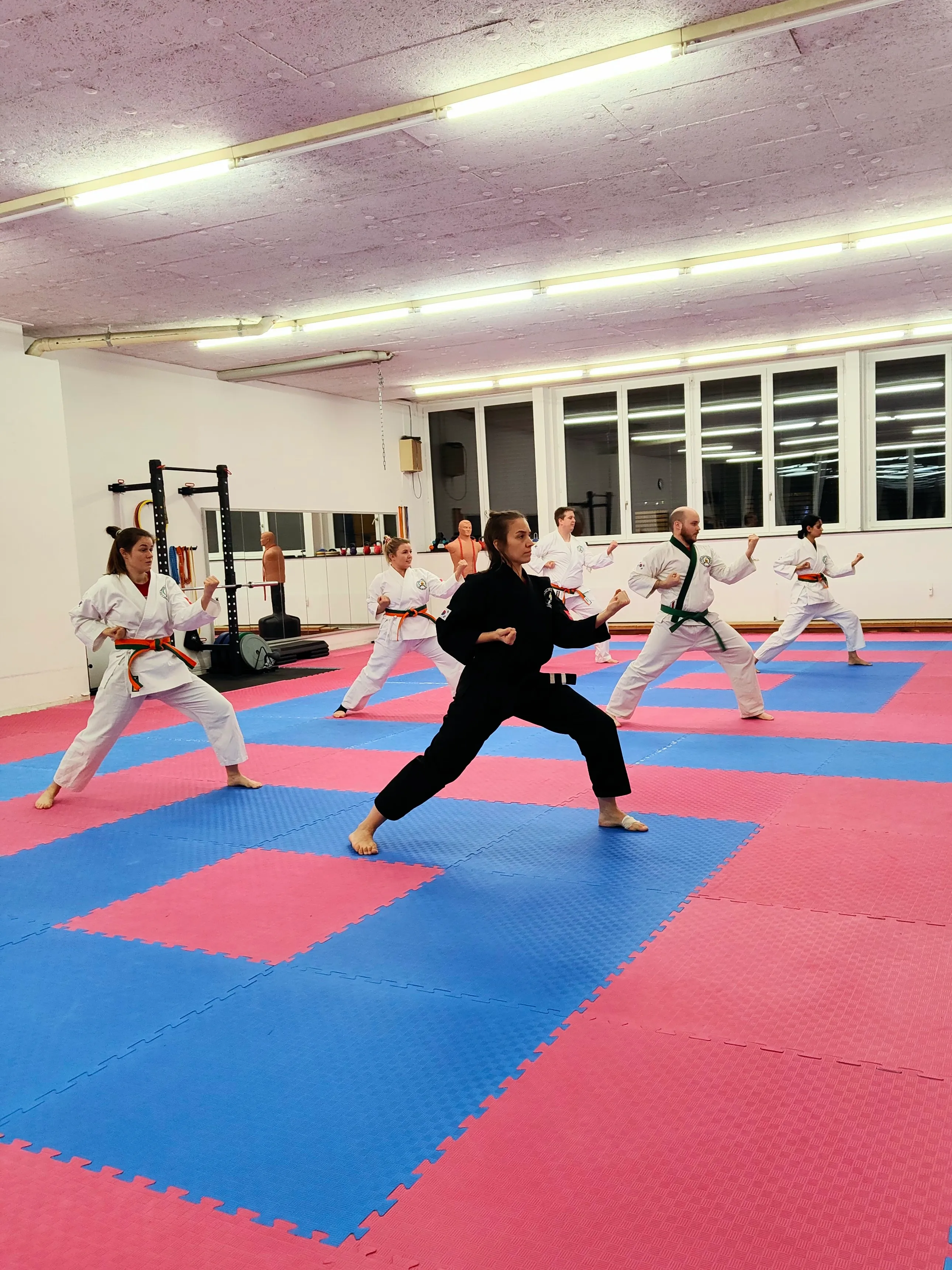
💪 The Hidden Power of Traditional Forms
You walk into a modern martial arts studio expecting to learn some kicks, maybe break a sweat, and definitely not to spend time practicing what looks like… choreographed dancing? Yet there you are, watching your instructor demonstrate a series of precise, flowing movements that seem to have nothing to do with actual fighting. Welcome to the world of traditional forms – and before you roll your eyes, hear us out.
What Are Forms, Really?
Think of traditional forms (“hyung” or “poomsae” in Korean martial arts like Hwalmoodo) as martial arts’ greatest hits album. Each movement represents a technique that has been tested, refined, and passed down through generations. It’s like having access to centuries of martial arts wisdom, all packaged into choreographed sequences that you can practice anywhere – no partner required.
But here’s where it gets interesting: forms aren’t just about preserving the past. They’re actually one of the most effective training tools for modern practitioners, whether you’re interested in self-defense, fitness, or competitive applications.
Here’s the key to understanding what forms really are: think of them like MIDI files in music – they contain all the essential data, the pure structure and timing, but they’re not the final performance. When you apply these concepts in sparring or real situations, they transform into something richer and more complex, like converting that MIDI into live audio with all its nuances and variations.
The Workout You Didn’t Know You Needed
Let’s talk about what’s really happening when you practice forms. You’re essentially doing:
Functional movement patterns – Every punch, block, and stance mimics real-world movements that strengthen your core, improve your balance, and enhance your coordination. That low block you’re practicing? It’s building hip mobility and leg strength in ways your gym routine probably isn’t.
Active meditation – When you’re focused on getting each movement precise, your mind can’t wander to your endless to-do list. It’s mindfulness in motion, which research shows reduces stress and improves mental clarity.
Cardiovascular conditioning – Try running through a complete form with proper intensity and tell us you’re not breathing hard. It’s interval training disguised as art.
Memory and cognitive function – Learning and remembering sequences of movements creates new neural pathways and keeps your brain sharp. It’s like sudoku, but you’re also getting ripped.
🥊 Why Your Kickboxing Gets Better with Forms
Here’s something that might surprise you: practicing traditional forms actually enhances your modern martial arts training. How? Forms teach you to move with intention and control. Every technique has a purpose, every transition has meaning.
You might notice that most traditional punches are straight-line techniques – hooks and circular movements are rare. This isn’t a limitation; it’s intentional design, like a vector graphic that maintains mathematical precision and clarity. Straight punches maintain the efficiency of positive and negative muscle contractions that forms are built around, and they embody the principle of taking the shortest distance to reach a target.
Forms aren’t meant to be a complete fighting manual – they’re the foundation template upon which everything else is built. When you practice a punch in a form, you’re learning to engage your whole body, to understand timing, to develop the kind of precise control that enhances all your martial arts training. The balance you develop holding stances translates to better footwork. The coordination you build executing combinations flows naturally into any martial arts application.
Think of forms as your movement vocabulary. The bigger your vocabulary, the more eloquently you can “speak” in martial arts. Once you understand these fundamental mechanics, adding hooks, complex combinations, and sport-specific techniques becomes much easier because you already have the essential movement foundation.
Build Your Complete Foundation
The beauty of forms is in their systematic approach to building physical literacy. Every time you practice, you’re refining something – maybe today it’s your balance, tomorrow it’s your timing, next week it’s the power generation in your techniques.
The balance you develop holding stances creates stability for any athletic endeavor. The coordination you build executing precise sequences enhances your ability to learn new movement patterns. The body awareness you gain helps you move through the world with confidence and grace.
Forms in the Real World
“But when am I ever going to use this exact sequence?” you might ask. You’re missing the point. Forms aren’t about memorizing choreography for real situations. They’re about developing the physical and mental tools that make you capable and confident in any situation.
The balance you develop prevents falls. The body awareness helps you navigate crowded spaces with grace. The mental discipline carries over into every aspect of your life. The stress relief… well, that one’s pretty obvious after a rough day.
📈 It’s Not About Perfection
One of the biggest misconceptions about forms is that they have to be perfect to be valuable. Not true. Forms are about progress, not perfection. That awkward sequence you’re struggling with today? In six months, it’ll flow naturally, and you’ll be working on new subtleties. There’s always another layer to discover, which is what keeps forms practice engaging for decades.
In our fast-paced, results-oriented world, forms can feel frustratingly slow and indirect. We want immediate, obvious benefits. But sometimes the most valuable things require patience and trust in the process.
Forms connect you to something larger than yourself – a lineage of practitioners who found value in these movements and passed them down because they worked. There’s something humbling and inspiring about practicing the same fundamental principles that warriors, athletes, and everyday people have used for centuries to build strength, character, and skill.
The Bottom Line
Traditional forms aren’t relics gathering dust in martial arts museums. They’re living, breathing training tools that happen to come with a rich history attached. They make you stronger, more coordinated, mentally sharper, and provide the foundation for every other aspect of your martial arts journey.
Plus, there’s something deeply satisfying about mastering a form – it’s like solving a puzzle with your whole body. And in a world where we spend most of our time sitting and staring at screens, moving with purpose and intention feels pretty revolutionary.
So the next time you’re practicing forms, remember: you’re not just preserving tradition. You’re downloading centuries of refined movement wisdom into your body, one precise technique at a time. And honestly? That’s pretty awesome.
Ready to experience the power of traditional forms as the foundation for complete martial arts training? Join us at HMD Basel and discover how Hwalmoodo’s traditional principles enhance every aspect of your physical and mental development.
AI-Assisted Content: This article was written with AI support. However, the core content, insights, and expertise are original and have been carefully reviewed by our team.